Why SAP PP Consultants Must Understand the Factory, Not Just MRP

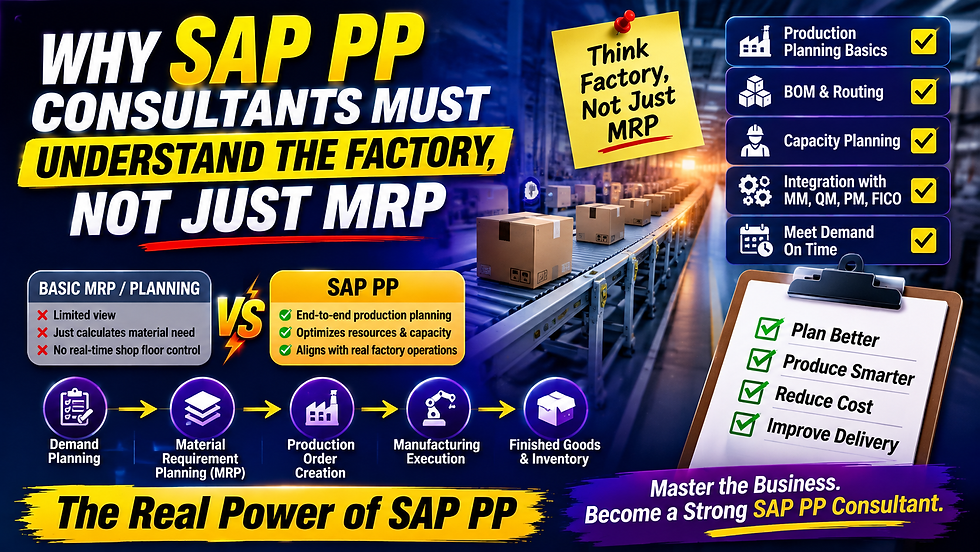
When people start learning SAP Production Planning (PP), they usually focus on MRP, BOM, Routing, Work Centers, Production Orders, and configuration.
All of these are important.
But there is something even more important for becoming a good SAP PP consultant:
You need to understand how a factory actually works.
Because SAP PP is not just about planning materials in a system.
It is about helping a business answer some very practical questions:
What should we produce? How much should we produce? When should we produce it? And do we have the materials and capacity to do it?
SAP PP Starts with a Business Requirement
Imagine a company manufactures bicycles.
The business receives demand for 1,000 bicycles next month.
For a learner, this may immediately become an MRP exercise.
But a consultant thinks differently.
Before running anything, they want to understand:
Do we have enough raw materials?
How many bicycles are already in stock?
What components need to be purchased?
How much production capacity is available?
Which machines and people are required?
How long will production take?
Can we meet the customer's required date?
Now you are no longer simply learning MRP.
You are thinking about production planning.

MRP Is a Tool, Not the Entire Process
MRP is one of the most important concepts in SAP PP.
But MRP does not magically solve production problems.
It calculates requirements based on the information available in the system.
If your master data or planning assumptions are incorrect, your planning results can also be incorrect.
For example, imagine the system says that manufacturing one bicycle requires two wheels.
If the BOM is wrong and contains only one wheel, MRP will plan the wrong quantity.
The system may work perfectly.
But the factory will have a problem.
This is why consultants need to understand both SAP and the physical business process behind SAP.
Understand the Story Behind the Master Data
A learner may memorize:
Material Master → BOM → Work Center → Routing → Production Version
A consultant asks what each object represents in the factory.
The BOM tells us what components are required.
The Routing tells us how the product will be manufactured.
The Work Center tells us where the operation will happen and what capacity is available.
The Production Version connects the appropriate production method.
Once you understand the business meaning behind these objects, SAP PP becomes much easier to understand.

Production Doesn't Work in Isolation
Another major mistake is learning PP as an isolated module.
A factory does not operate that way.
Suppose MRP determines that a component is missing.
Someone needs to procure it.
That connects PP with Materials Management.
When production consumes raw materials, inventory changes.
When finished goods are produced, inventory changes again.
Production activities also create costs that ultimately impact Finance and Controlling.
Quality checks may involve Quality Management.
Equipment problems may involve Plant Maintenance.
This means a strong PP consultant should understand how production connects with the larger business process.
A Real Consultant Thinks About Exceptions
Training often teaches you the ideal process.
But projects are full of exceptions.
What happens if:
A machine suddenly breaks down?
A supplier delivers material late?
Customer demand increases unexpectedly?
Production takes longer than planned?
A component is rejected during quality inspection?
The factory does not have enough capacity?
These are the situations where consulting skills become important.
A good consultant doesn't only know how the standard process works.
They understand what the business should do when the standard process doesn't work as expected.
How Should You Learn SAP PP?
Whenever you learn a new PP topic, don't just ask:
"How do I configure this?"
Also ask:
Why does the factory need this?
What physical activity does this represent?
What information does the planner need?
What happens before this step?
What happens after this step?
Which other departments are involved?
What happens if the data is incorrect?
What business problem is SAP solving here?
These questions completely change your learning approach.
From SAP PP Learner to SAP PP Consultant
Knowing how to run MRP is knowledge.
Understanding why MRP generated a particular proposal is consulting.
Knowing how to create a Production Order is knowledge.
Understanding whether that order can realistically be executed on the shop floor is consulting.
Knowing how to maintain a BOM is knowledge.
Understanding how an incorrect BOM can stop production is consulting.
That is the difference you should work toward.
Final Thoughts
Don't learn SAP PP only from the system screen.
Try to visualize the factory behind every transaction.
Think about the materials arriving.
Think about machines running.
Think about people performing operations.
Think about components being consumed.
Think about finished products coming out of production.
And then ask yourself:
How is SAP helping the business plan and control all of this?
Once you start thinking this way, SAP PP stops being a collection of transactions and configuration steps.
It becomes a real business process.
And that is where your journey from an SAP PP learner to an SAP PP consultant really begins.
Want to Build Your SAP PP Career?
If you're learning SAP PP and have questions about your learning roadmap, interviews, business processes, or career direction, share your query with us.
Our experts will personally review your query and try to guide you in the right direction.
Ask Your SAP Career Query:https://sastrageek.com/contact
Free SAP Micro Learning – 300+ Videos & 50+ Downloadable Resources:https://sastrageek.com/ml
WhatsApp Support:https://sastrageek.com/wa
Email:support@sastrageek.com
Website:https://www.sastrageek.com
#SAPPP #ProductionPlanning #SAPS4HANA #SAPConsultant #SAPCareer #Manufacturing #MRP #ProductionPlanning #SAPTraining #SAPLearning #BusinessProcess #ManufacturingPlanning #SupplyChain #ERP #Sastrageek


My daughter went straight for archery and the throwing targets, which I'd never have guessed. Worth browsing the experience list together - kids pick things you wouldn't pick for them.
I appreciated the useful details because they make the subject easier to understand. I tried Crazy Ball 3D Online and enjoyed working toward a better distance. Each attempt gives players a chance to learn from mistakes, collect more diamonds, and improve their movement on the track.