The Biggest Difference Between an SAP Student and an SAP Consultant

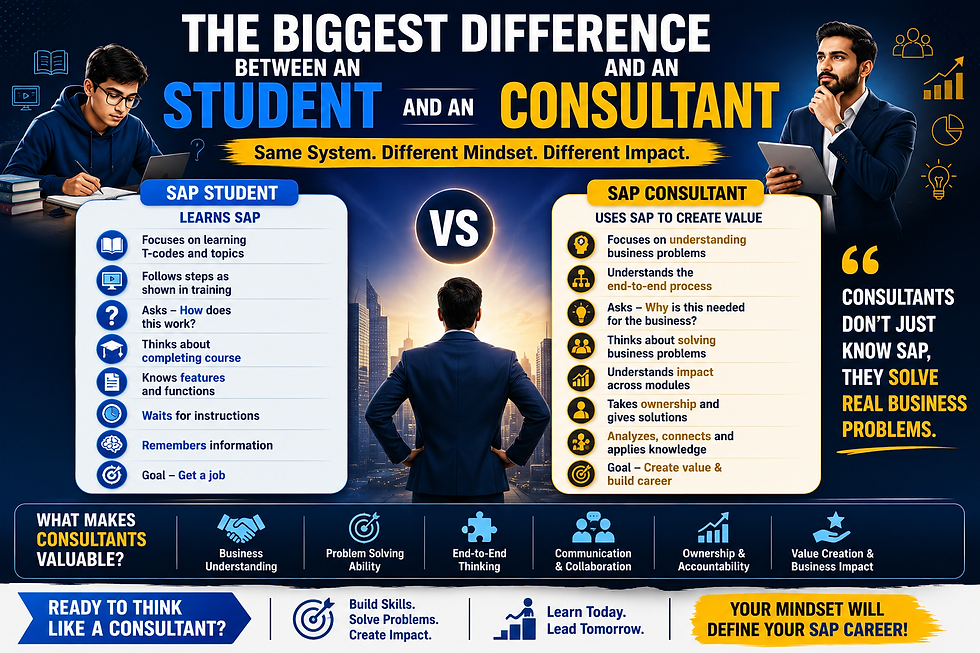
If you ask most SAP learners what their goal is, the answer is usually simple:
"I want to become an SAP Consultant."
But very few people stop and ask an important question:
What actually makes someone an SAP consultant?
Is it completing an SAP course?
Is it knowing transaction codes?
Is it clearing a certification?
The answer is no.
The biggest difference between an SAP student and an SAP consultant is not the amount of SAP knowledge they have.
It's the way they think.
An SAP Student Learns SAP
An SAP student focuses on learning.
They attend classes, watch videos, complete assignments, and memorize concepts.
Their questions are usually:
What is this transaction?
Which configuration step comes next?
What is the definition of this process?
This stage is important because every consultant starts as a student.
But staying in this stage for too long limits your growth.

An SAP Consultant Uses SAP to Solve Business Problems
A consultant looks at SAP differently.
Instead of asking, "What is this transaction?"
They ask:
Why does the business need this?
What problem is this solving?
What happens if this process fails?
Which other departments are affected?
What is the best solution for the client?
Their focus is not on SAP itself.
Their focus is on the business.
SAP is simply the tool they use.
A Simple Example
Imagine you are learning the Sales Order process.
An SAP student might remember:
The transaction used to create a Sales Order.
The required master data.
The document flow.
An SAP consultant thinks beyond that.
They ask:
Why is the Sales Order not being created?
Why is pricing incorrect?
Why is delivery blocked?
How does this affect inventory, finance, and customer satisfaction?
What is the root cause, and how can it be fixed?
Both people know SAP.
But only one is thinking like a consultant.
The Real Difference
An SAP Student:
Learns features.
Memorizes concepts.
Focuses on completing the course.
Waits for instructions.
Thinks about passing interviews.
An SAP Consultant:
Understands business processes.
Solves business problems.
Connects different SAP modules.
Takes ownership.
Thinks about creating value for the business.
This shift in mindset is what separates average professionals from highly valued consultants.
How Can You Make This Transition?
Every time you learn a new SAP topic, ask yourself these questions:
How is this used in the business?
Which business process depends on it?
What happens if it doesn't work correctly?
How would I explain this to a client?
What interview questions can come from this topic?
These questions train your brain to think beyond the screen.
Over time, you will naturally develop consulting skills.
Final Thoughts
Every SAP consultant starts as a student.
But successful consultants don't stop at learning SAP.
They learn how businesses operate.
They understand why processes exist.
They connect technology with business value.
Remember:
An SAP student learns the system.
An SAP consultant improves the business using the system.
The sooner you make this mindset shift, the sooner you'll become more confident in interviews, client discussions, and real SAP projects.
Ready to Become an SAP Consultant?
If you're learning SAP and want to build consultant-level thinking, our team is here to help.
We can guide you with interview preparation, business process understanding, and practical learning approaches that prepare you for real projects.
Contact Sastrageek Solutions
Ask Your SAP Career Query: https://sastrageek.com/contact
Free SAP Micro Learning (300+ Videos): https://sastrageek.com/ml
WhatsApp Support: https://sastrageek.com/wa
Email: support@sastrageek.com
Website: https://www.sastrageek.com
#SAP #SAPCareer #SAPConsultant #SAPTraining #SAPS4HANA #SAPLearning #BusinessProcess #ConsultingSkills #CareerGrowth #SAPJobs #ERP #ProfessionalDevelopment #Sastrageek


The raj sso login facility is convenient for people who use several government applications and want to manage their online services through one account.
Digital government services have made record management much simpler than before. The MP Samagra system provides useful facilities for citizens to access family-related information and other services online, reducing the need to depend completely on physical paperwork.
This piece provides a fresh and compelling take on the subject. I admire your ability to convey such detailed information in an accessible way. choicer voicer packs
I think Land Record MP services are useful for property owners who need quick access to information. Online availability can save time, particularly when someone needs to review records before discussing a property-related matter.
Students searching for the MPTAAS Scholarship can benefit from detailed online guidance. I found the information easy to understand, and it provides a useful starting point for applicants who are unfamiliar with the scholarship application process.